
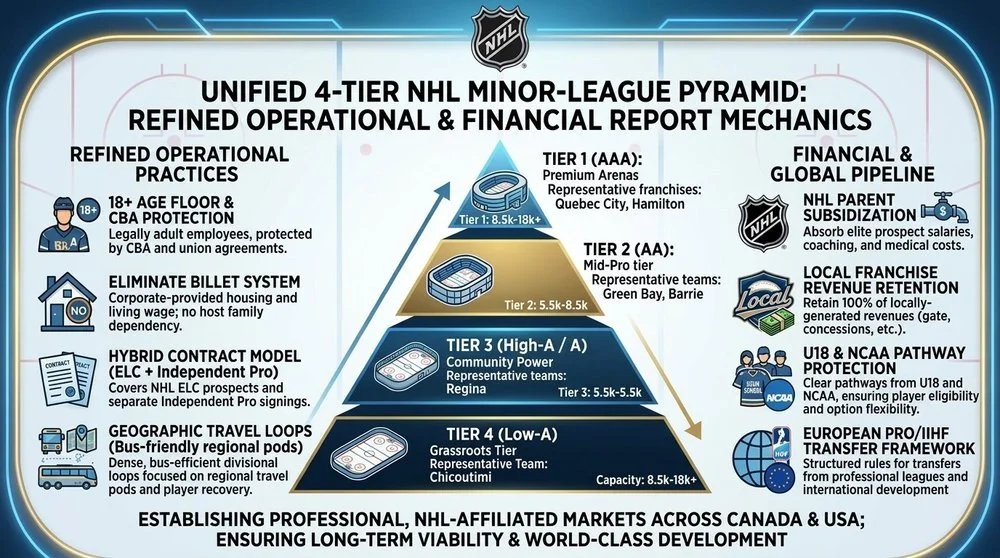
Executive Summary
The 4-Tier Minor League Hockey System fundamentally reimagines North American hockey development by consolidating the fragmented matrix of the American Hockey League (AHL), East Coast Hockey League (ECHL), Federal Prospects Hockey League (FPHL), Southern Professional Hockey League (SPHL), and the Canadian Hockey League (CHL major junior loops: WHL, OHL, QMJHL), alongside USHL and junior outposts.
Overseen directly by the NHL and structured on the streamlined hierarchy of Major League Baseball (MLB), this proposal establishes a unified 128-team professional pyramid spanning Tier 1 (AAA), Tier 2 (AA), Tier 3 (High-A), and Tier 4 (Low-A). By establishing a clear developmental ladder, implementing a hybrid contract model, protecting U18 player pathways (NCAA, European pro, and Junior A/B/C feeders), and balancing regional bus loops, this proposal guarantees economic sustainability for local owners, optimal prospect development for parent clubs, and a modern, legally sound workplace for all players.
┌─────────────────────────────────────────┐
│ TIER 1 (AAA) │
│ 32 Teams | Premium Arenas (8.5k-18k+) │
└────────────────────┬────────────────────┘
│
┌────────────────────┴────────────────────┐
│ TIER 2 (AA) │
│ 32 Teams | Mid-Pro Hubs (5.5k-8.5k) │
└────────────────────┬────────────────────┘
│
┌────────────────────┴────────────────────┐
│ TIER 3 (HIGH-A) │
│ 32 Teams | Community Power (3.5k-5.5k) │
└────────────────────┬────────────────────┘
│
┌────────────────────┴────────────────────┐
│ TIER 4 (LOW-A) │
│ 32 Teams | Grassroots Pro (2.0k-3.5k) │
└─────────────────────────────────────────┘
1. Ethical & Human-Centric Mandate
This system addresses the systemic human rights, legal, labor, and behavioral challenges inherent to the traditional major junior model.
Professionalization & CBA Coverage: Junior hockey has historically relied on classifying teenage athletes as "student-athletes" or amateur independent contractors to bypass labor standards, triggering chronic minimum-wage lawsuits and antitrust litigation. The 4-Tier system establishes professional standards where rostered adult players operate under a Collective Bargaining Agreement (CBA) with union representation (e.g., Professional Hockey Players' Association - PHPA).
Eradication of the Billet System: Outsourcing the upbringing of 16-to-20-year-olds to local host families created institutional and personal safety risks. Under this model, traditional billeting is eliminated for adult professional teams and replaced with corporate-provided housing, living-wage compensation, professional security, and independent adult living arrangements.
Deconstructing Toxic Teen Celebrity: Marketing 16-year-old athletes as local celebrities created intense psychological pressure and environments of unearned privilege, occasionally contributing to locker-room toxicity. Shifting roster spots to adult professionals replaces teenage celebrity with a grounded community sports model.
Responsible "Hometown Hero" Narrative: Through independent team-specific contracts, franchises can sign local university graduates or un-drafted community veterans. Fans still cheer for local talent, but that talent consists of adult athletes equipped to handle the public spotlight.
2. Structural, Roster & Development Mechanics
A. The Hybrid Contract System
Borrowing the best elements of AHL independent operations while avoiding MLB’s total roster control model, each pyramid franchise utilizes a Dual-Contract Structure:
NHL-Signed Prospects: Elite drafted prospects paid directly by an NHL parent club under Entry-Level Contracts (ELCs).
Tier-Specific / Team Contracts: Independent adult contracts signed directly by local franchises to build roster depth and regional continuity.
B. Service-Time Limits & Veteran Roster Quotas
Rather than imposing rigid age caps across the adult tiers (which would strip minor-league veterans of their livelihood), lower tiers manage roster balance using Professional Service-Time Caps (similar to MiLB):
Tier 4 (Low-A): Roster limits restrict teams to carrying a maximum of 3 to 4 players with more than 4 years of professional experience, reserving the majority of roster spots for young developing talent.
Tiers 1–3: Gradually scale service-time allowances to accommodate top prospect development, call-ups, and seasoned minor-league veterans.
3. The Under-18 (U18) Pipeline & Global Feeder Network
To ensure 16- and 17-year-old prospects are not rushed into full-time adult pro hockey prematurely—and to preserve global talent pathways—the pyramid operates with an External Feeder Network model:
=========================================
TIER 1 (Triple-A) <--> 32 Pro Teams
TIER 2 (Double-A) <--> 32 Pro Teams
TIER 3 (High-A) <--> 32 Pro Teams
TIER 4 (Low-A) <--> 32 Pro/Junior Hybrid
=========================================
│
(Pyramid Entry Draft & Developmental Loans)
│
┌───────────────────────────┼───────────────────────────┐
│ │ │
[ NCAA Hockey ] [ European Pro & U20 ] [ Junior A / B / C ]
(US College Loop) (SHL, Liiga, NL, J20) (CJHL / USHL / Local)
• Education Stipends • 4-Year Draft Rights • Territorial Rights
• Unsigned Draft Rights • Overseas Loans • Grassroots Academies
A. Tier 4 as a Pro/Junior Hybrid Gateway
U18 Roster Quotas: Tier 4 clubs carry a mandatory quota of 3 to 5 U18 developmental contracts on their active roster.
Developmental Amateur Status: To protect NCAA eligibility for high school players, Tier 4 contracts can be structured as Developmental Amateur Contracts (providing housing, educational stipends, and tutoring without professional salary wages).
B. Two-Track Draft System
The Central Pyramid Entry Draft (Age 18): An annual multi-round draft for 18-year-old prospects globally. Draft order is inverse to standings across the pyramid, weighted by Tier. Tier 1 parent teams hold drafted player rights for 3 years (or 4 years for players in college or European systems).
Territorial Priority Picks: Tier 3 and Tier 4 clubs receive 2 Protected Territorial Picks annually to sign elite local U18 prospects from their regional junior academies before the main draft.
C. Integration of NCAA, European, and Junior Feeder Leagues
NCAA Bridge: Drafted players can attend and play NCAA college hockey while their pyramid rights remain secured by their drafting club for up to 4 years.
European Assignment Clause: Tier 1 and Tier 2 clubs can draft European prospects and leave them on loan with their home SHL, Liiga, or NL clubs (or loan North American prospects overseas) under standardized IIHF-Pyramid Transfer Protocols.
Junior A/B/C Grassroots Hubs: Regional leagues (e.g., CJHL, GOJHL, PJHL) function as official feeder academies for Tier 3 and Tier 4 teams, earning Developmental Transfer Fees when their players sign professional contracts.
4. Financial Architecture
┌─────────────────────────────────┐
│ NHL PARENT CLUBS │
│ Absorbs Elite Prospect Salaries, │
│ Coaching Staff, Medical & Equipment │
└────────────────┬────────────────┘
│ Subsidizes High-End Costs
▼
┌─────────────────────────────────┐
│ LOCAL FRANCHISES │
│ Covers Rent, Operations & Local │
│ Roster | Retains 100% Revenues │
└─────────────────────────────────┘
Capital Cost Subsidization: NHL parent organizations absorb major prospect development costs—ELC prospect salaries, specialized coaching staff, high-end equipment, and medical rehabilitation.
Grassroots Revenue Retention: Local franchise owners operate in modern or upgraded venues, funding local arena lease terms, front-office operations, and local player contracts while retaining 100% of local revenues (gate receipts, luxury suites, concessions, parking, and regional sponsorships).
5. Tier Classification & Placement Matrix
Franchises are distributed across the four tiers based on market population, venue capacity, historical attendance data (2021–2026 verification), and regional infrastructure:
Tier
Capacity Floor
Average Attendance Target
Primary Geographic & Market Profile
Representative Markets
Tier 1 (AAA)
8,500 – 18,000+
6,500 – 11,000+
Major regional hubs, top AHL anchors, premium major junior centers
Quebec City, Hamilton, London, Halifax, Hershey, Grand Rapids, Kansas City, San Diego
Tier 2 (AA)
5,500 – 8,500
4,000 – 6,500
Mid-sized pro markets, top ECHL hubs, upper-tier junior centers
Jacksonville, Orlando, Guelph, Windsor, Kelowna, Red Deer
Tier 3 (High-A)
3,500 – 5,500
2,500 – 4,000
Regional community anchors, dense minor-pro footprints, core junior hubs
Barrie, Brantford, Erie, Kalamazoo, Regina, Rapid City, Bridgeport, Rimouski
Tier 4 (Low-A)
2,000 – 3,500
1,500 – 2,500
Grassroots entry-pro markets, USHL hubs, QMJHL/WHL venues, minor-pro outposts
Chicoutimi, Shawinigan, Charlottetown, Tahoe, Penticton, Swift Current, Flint, Port Huron
6. Complete 128-Team Master Divisional Alignment
Tier 1 (Triple-A / AAA) — 32 Teams
Western Conference (16 Teams)
--------------------------------------------------
Pacific Division (8 Teams)
• Abbotsford Canucks (Abbotsford, BC)
• Bakersfield Condors (Bakersfield, CA)
• Coachella Valley Firebirds (Palm Desert, CA)
• Iowa Wild (Des Moines, IA)
• Ontario Reign (Ontario, CA)
• San Diego Gulls (San Diego, CA)
• Spokane Chiefs (Spokane, WA)
• Texas Stars (Cedar Park, TX)
Midwest Division (8 Teams)
• Fort Wayne Komets (Fort Wayne, IN)
• Grand Rapids Griffins (Grand Rapids, MI)
• Hamilton Hammers (Hamilton, ON)
• Kansas City Mavericks (Independence, MO)
• Kitchener Rangers (Kitchener, ON)
• London Knights (London, ON)
• Milwaukee Admirals (Milwaukee, WI)
• Sioux Falls Stampede (Sioux Falls, SD)
Eastern Conference (16 Teams)
--------------------------------------------------
Mideast Division (8 Teams)
• Cleveland Monsters (Cleveland, OH)
• Halifax Mooseheads (Halifax, NS)
• Lehigh Valley Phantoms (Allentown, PA)
• Providence Bruins (Providence, RI)
• Quebec Remparts (Quebec City, QC)
• Rochester Americans (Rochester, NY)
• Syracuse Crunch (Syracuse, NY)
• Toledo Walleye (Toledo, OH)
Atlantic Division (8 Teams)
• Charlotte Checkers (Charlotte, NC)
• Cincinnati Cyclones (Cincinnati, OH)
• Florida Everblades (Estero, FL)
• Greenville Swamp Rabbits (Greenville, SC)
• Hershey Bears (Hershey, PA)
• Jacksonville Icemen (Jacksonville, FL)
• Orlando Solar Bears (Orlando, FL)
• Savannah Ghost Pirates (Savannah, GA)
Tier 2 (Double-A / AA) — 32 Teams
Western Conference (16 Teams)
--------------------------------------------------
Pacific Division (8 Teams)
• Idaho Steelheads (Boise, ID)
• Kamloops Blazers (Kamloops, BC)
• Kelowna Rockets (Kelowna, BC)
• Portland Winterhawks (Portland, OR)
• Saskatoon Blades (Saskatoon, SK)
• Tahoe Knight Monsters (Stateline, NV)
• Tucson Roadrunners (Tucson, AZ)
• Wichita Thunder (Wichita, KS)
Midwest Division (8 Teams)
• Green Bay Gamblers (Green Bay, WI)
• Huntsville Havoc (Huntsville, AL)
• Indy Fuel (Fishers, IN)
• Pensacola Ice Flyers (Pensacola, FL)
• Peoria Rivermen (Peoria, IL)
• Quad City Storm (Moline, IL)
• Rockford IceHogs (Rockford, IL)
• Tulsa Oilers (Tulsa, OK)
Eastern Conference (16 Teams)
--------------------------------------------------
Great Lakes & North Division (8 Teams)
• Adirondack Thunder (Glens Falls, NY)
• Belleville Senators (Belleville, ON)
• Guelph Storm (Guelph, ON)
• Moncton Wildcats (Moncton, NB)
• Oshawa Generals (Oshawa, ON)
• Utica Comets (Utica, NY)
• Wilkes-Barre/Scranton Penguins (Wilkes-Barre, PA)
• Windsor Spitfires (Windsor, ON)
Atlantic Division (8 Teams)
• Atlanta Gladiators (Duluth, GA)
• Hartford Wolf Pack (Hartford, CT)
• Maine Mariners (Portland, ME)
• Norfolk Admirals (Norfolk, VA)
• Roanoke Rail Yard Dawgs (Roanoke, VA)
• South Carolina Stingrays (North Charleston, SC)
• Springfield Thunderbirds (Springfield, MA)
• Worcester Railers (Worcester, MA)
Tier 3 (High-A) — 32 Teams
Western Conference (16 Teams)
--------------------------------------------------
Pacific Division (8 Teams)
• Chilliwack Bruins (Chilliwack, BC)
• Lethbridge Hurricanes (Lethbridge, AB)
• Medicine Hat Tigers (Medicine Hat, AB)
• Penticton Vees (Penticton, BC)
• Prince George Cougars (Prince George, BC)
• Red Deer Rebels (Red Deer, AB)
• Tri-City Americans (Kennewick, WA)
• Victoria Royals (Victoria, BC)
Midwest (8 Teams)
• Bloomington Bison (Bloomington, IL)
• Brandon Wheat Kings (Brandon, MB)
• Evansville Thunderbolts (Evansville, IN)
• Fargo Force (Fargo, ND)
• Lincoln Stars (Lincoln, NE)
• Moose Jaw Warriors (Moose Jaw, SK)
• Rapid City Rush (Rapid City, SD)
• Regina Pats (Regina, SK)
Eastern Conference (16 Teams)
--------------------------------------------------
Mideast Division (8 Teams)
• Barrie Colts (Barrie, ON)
• Brantford Bulldogs (Brantford, ON)
• Kalamazoo Wings (Kalamazoo, MI)
• Niagara IceDogs (St. Catharines, ON)
• Peterborough Petes (Peterborough, ON)
• Saginaw Spirit (Saginaw, MI)
• Sarnia Sting (Sarnia, ON)
• Sault Ste. Marie Greyhounds (Sault Ste. Marie, ON)
Atlantic Division (8 Teams)
• Bridgeport Islanders (Bridgeport, CT)
• Erie Otters (Erie, PA)
• Fayetteville Marksmen (Fayetteville, NC)
• Gatineau Olympiques (Gatineau, QC)
• Knoxville Ice Bears (Knoxville, TN)
• Rimouski Océanic (Rimouski, QC)
• Shawinigan Cataractes (Shawinigan, QC)
• Sudbury Wolves (Sudbury, ON)
Tier 4 (Low-A) — 32 Teams
Western Conference (32 Teams)
--------------------------------------------------
Northwest Division (8 Teams)
• Cedar Rapids RoughRiders (Cedar Rapids, IA)
• Omaha Lancers (Omaha, NE)
• Prince Albert Raiders (Prince Albert, SK)
• Sioux City Musketeers (Sioux City, IA)
• Swift Current Broncos (Swift Current, SK)
• Tri-City Storm (Kearney, NE)
• Vernon Vipers (Vernon, BC)
• Wenatchee Wild (Wenatchee, WA)
Midwest Division (8 Teams)
• Flint Firebirds (Flint, MI)
• Kingston Frontenacs (Kingston, ON) — Swapped with Wheeling for 401/Great Lakes pod
• Madison Capitols (Madison, WI)
• Muskegon Lumberjacks (Muskegon, MI)
• North Bay Battalion (North Bay, ON)
• Owen Sound Attack (Owen Sound, ON)
• Port Huron Prowlers (Port Huron, MI)
• Youngstown Phantoms (Youngstown, OH)
Eastern Conference (32 Teams)
--------------------------------------------------
Mideast Division (8 Teams)
• Binghamton Black Bears (Binghamton, NY)
• Chicoutimi Saguenéens (Saguenay, QC)
• Drummondville Voltigeurs (Drummondville, QC)
• Elmira River Sharks (Elmira, NY)
• Reading Royals (Reading, PA)
• Sherbrooke Phœnix (Sherbrooke, QC)
• Trois-Rivières Lions (Trois-Rivières, QC)
• Wheeling Nailers (Wheeling, WV) — Swapped with Kingston for Tri-State/Mid-Atlantic loop
Atlantic Division (8 Teams)
• Cape Breton Eagles (Sydney, NS)
• Carolina Thunderbirds (Winston-Salem, NC)
• Charlottetown Islanders (Charlottetown, PE)
• Columbus River Dragons (Columbus, GA) — Reunited with Macon (90-min derby loop)
• Edmundston Blizzard (Edmundston, NB)
• Macon Mayhem (Macon, GA) — Reunited with Columbus (90-min derby loop)
• Newfoundland Regiment (St. John's, NL)
• Saint John Sea Dogs (Saint John, NB)
7. Summary of Geographic & Structural Integrity
Strict Mathematical Balance: Exactly 128 teams, divided into 4 tiers of 32 teams, 2 conferences of 16 teams, and 4 divisions of 8 teams.
Optimized Bus-League Logistics: Lower tiers leverage tight regional loops (e.g., the 90-minute Georgia derby in Tier 4 between Macon and Columbus, the Highway 401 Ontario corridor, and the Tri-State PA/WV/NY loop).
Comprehensive Player Pathway: U18 players develop cleanly through protected channels (NCAA, European loans, Junior A academies, and Tier 4 amateur contracts) without threatening legal status or education.
Economic Sustainability: NHL parent clubs fund top prospect overhead while local owners leverage full venue control and community fandom to ensure long-term profitability across all 128 North American markets.