Waterloo Region Restructuring & Rebranding Advocacy: Amalgamate Top-Tier Region of Waterloo, Rename “City of Grand River”
Last updated: 2026/09/21
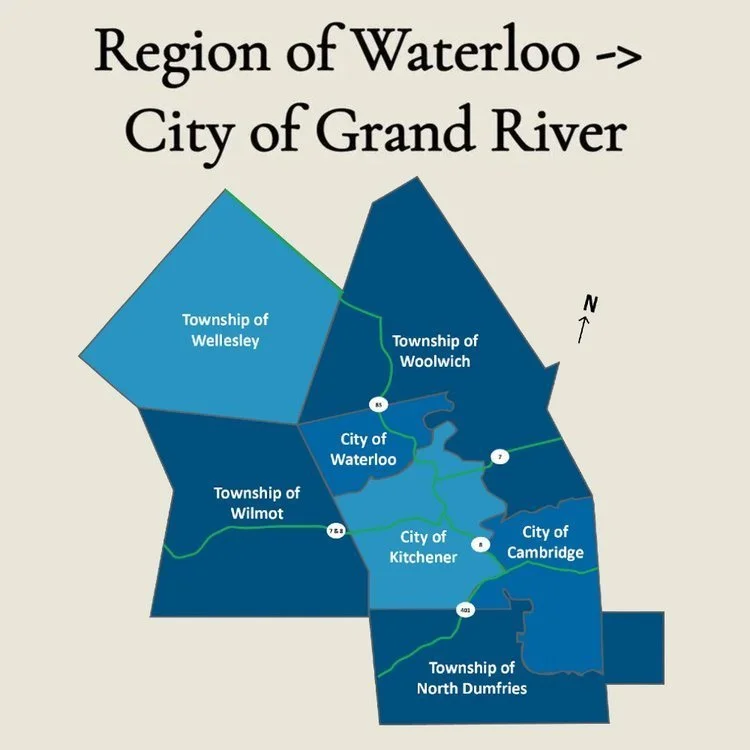
1. Advocate to Government of Ontario for Dissolution of Top-Tier "Region of Waterloo"
The Rationale: Why This Matters
Reduce bureaucratic duplication: Eliminate redundant services and administrative layers between the regional and lower-tier governments. This could lead to a single point of contact for citizens and businesses.
Streamline decision-making: Accelerate critical decisions, particularly for housing and land development, which are often delayed by the two-tier structure.
Improve local accountability: A single, transparent council would be directly responsible for all municipal services, making it easier for citizens to hold their elected officials accountable.
Lead to long-term cost savings: By consolidating services, a single-tier system could reduce overhead and lead to significant financial efficiencies for taxpayers.
The Historical & Local Context
The Region was created by the province in 1973, a change that was imposed, not chosen by local residents, which has led to a long-standing debate over its effectiveness and purpose.
The recent provincial review of regional governments indicates a continued public and political interest in this issue as a potential solution to Ontario's housing crisis.
The Precedent: Examples from Elsewhere
The recent provincial decision to dissolve the Regional Municipality of Peel (though the timeline has been paused for further review) serves as a direct precedent that the Ontario government has the will and authority to make such a change.
Other Canadian cities, such as Toronto, Ottawa, Hamilton, Halifax and Winnipeg, moved to a single-tier model decades ago to improve efficiency and governance.
The Plan: Overcoming Obstacles
Requires a provincial government bill to legally dissolve the Region.
A transition board would need to be appointed to oversee the division of assets, debt, and services (e.g., police, public health, social services).
2. Advocate to Government of Ontario for Amalgamation of Lower-Tier "City of Kitchener" With "City of Waterloo"
The Rationale: Why This Matters
Create a single, powerful "megacity": A united city would have a stronger, more coherent voice for the urban core on the national and global stage.
Eliminate duplicated services: Consolidate city councils, fire departments, and recreation programs to reduce administrative overhead.
Allow for integrated planning: Enable more efficient and long-term planning for shared infrastructure like public transit, roads, and utilities.
The Historical & Local Context
The idea of a single "Kitchener-Waterloo" city has been debated since the 1960s.
The two cities already share a common name (K-W), public transit (GRT), and have a high degree of social and economic interdependence, with residents often moving between the two without noticing.
The Precedent: Examples from Elsewhere
The creation of the City of Toronto (1998), which amalgamated six municipalities, offers a Canadian example of a large-scale "megacity" project.
The formation of the City of Ottawa (2001) and the City of Hamilton (2001) provide additional Ontario-specific precedents.
The New York City model of a single, powerful city government with distinct boroughs offers a blueprint for how a united city can still contain separate, locally-branded communities.
The Plan: Overcoming Obstacles
Requires a Minister's Order from the provincial government.
Significant upfront costs for new signage, branding, and merging computer systems.
Requires a clear plan for harmonizing taxes and services, while preserving the unique identities of areas like Uptown Waterloo and Downtown Kitchener.
3. Advocate for City of Cambridge to Determine Own Fate in Referendum on Future Governance Structure
The Rationale: Why This Matters
Empower citizens: Give the people of Cambridge direct democratic choice to decide their own municipal boundaries and governance model rather than having a structure imposed by the province.
Honour distinct identities: Address long-standing local debates by allowing residents to weigh the value of local historical identity against regional integration.
Tailor local growth: Ensure that future development decisions match the distinct economic and geographic needs of the area, whether operating as an independent entity or part of a broader urban agglomeration.
The Historical & Local Context
The City of Cambridge was created by provincial fiat on January 1, 1973, forcibly merging the City of Galt, the Towns of Preston and Hespeler, the Village of Blair, and parts of North Dumfries and Waterloo.
Deep-seated local identities persist, with many residents maintaining strong ties to their original community roots.
The Options on the Ballot
A binding or non-binding municipal referendum would present Cambridge voters with three clear structural paths:
Dissolution into Component Communities: Breaking Cambridge apart to restore independent governance for Galt, Preston, Hespeler, and Blair.
Independent Single City: Remaining intact as the City of Cambridge, maintaining complete independence and separation from any new Kitchener-Waterloo municipal structure.
Amalgamation with K-W: Amalgamating the entirety of Cambridge (or specific component parts, such as Hespeler or Preston) into a larger unified K-W urban center.
The Precedent: Examples from Elsewhere
The de-amalgamation of several Quebec municipalities in 2006 (such as Côte Saint-Luc and Montreal West) demonstrates that reversing forced municipal mergers is legally and politically possible in Canada.
The Plan: Overcoming Obstacles
Requires provincial enabling legislation to authorize the referendum and outline the legal mechanism to implement whichever option wins the public vote.
A complex transition framework would be required to untangle or restructure shared assets, municipal debt, and service delivery depending on the referendum outcome.
4. Advocate for Referendum for Townships to Decide on Amalgamation with the New Kitchener-Waterloo City or Retain Independence
The Rationale: Why This Matters
A clear, democratic choice: Provide the remaining regional townships (North Dumfries, Wellesley, Wilmot, and Woolwich) with a direct choice on their long-term governance.
Protect rural and small-town interests: Give rural communities the agency to protect agricultural lands, local infrastructure priorities, and community character from being marginalized by a massive urban center.
The Historical & Local Context
Waterloo Region’s four townships possess unique rural and small-town identities that contrast sharply with the urban environments of Kitchener, Waterloo, and Cambridge.
The Precedent: Examples from Elsewhere
Surrounding regional structures in Ontario often balance dominant urban cores with independent, lower-tier townships that retain distinct governance models.
The Plan: Overcoming Obstacles
Referendums would need to be coordinated across the townships simultaneously to ensure equitable participation.
Safeguards and protective zoning would need to be legislated to protect agricultural land and rural service delivery if any township chose alignment.
5. Advocate for Referendum on Metropolitan and City Naming (Structuring a Unified Identity)
The Rationale: Why This Matters
Eliminate identity fragmentation: The region currently suffers from a confusing mix of identifiers (Waterloo Region, Tri-Cities, K-W), which causes real friction, confusion, and negative economic impacts for local businesses, entrepreneurs, and residents trying to communicate or conduct business across Canada and the world.
Adopt a geography-first, inclusive identity: While other options can be considered, my personal recommendation and the best choice is "City of Grand River" (for the amalgamated K-W urban center) or "Grand River Metropolitan Area" (if the broader region remains multi-tier).
Why "Grand River" is the ideal choice: It is elegant, honors the geography rather than a political or historical figure, and respects the Indigenous peoples to whom the river was vital long before the land was sold to the British Crown as the Haldimand Tract.
The flaws of retaining "Waterloo": Avoid keeping "Waterloo" as a blanket title because it is overly tied to the University of Waterloo—representing only a small segment of the population rather than the whole region—and the Battle of Waterloo carries historic and cultural baggage primarily important to people of British descent, which represents only a small portion of the modern City and Region of Waterloo.
The Historical & Local Context: The Berlin-to-Kitchener Change (1916)
A Necessary Shift, but a Brutal Process: Getting away from a German name during World War I—when Germany was the enemy—was necessary. However, the way it was handled was deeply problematic.
Intimidation and Violence: The 1916 renaming process was not a peaceful civic choice; it was heavily marred by intimidation, violence, and economic coercion directed against local citizens by the British/Canadian Crown and local battalions (such as the 118th Battalion ransacking German social clubs and assaulting preachers). The razor-thin 81-vote majority for the name change occurred under an atmosphere of intense fear.
A Flawed Namesake: The city was renamed after Field Marshal Horatio Herbert Kitchener, a British military figure whose legacy is heavily criticized internationally for brutal colonial tactics, including early concentration camps.
Read about Berlin to Kitchener name change, 1916
The Precedent: Examples from Elsewhere
The Gatineau-Hull Hockey Coincidence: Major regions worldwide anchor their identity in natural ecosystems and waterways (like the Ottawa-Gatineau region). A striking local connection is the amalgamation of Gatineau in 2003 from Hull, Aylmer, and Gatineau. In a fascinating quirk of sports history, the Hull Olympiques lost to the Kitchener Rangers in the 2003 Memorial Cup final, and then lost again in the 2004 Memorial Cup final as the exact same franchise, playing in the same city and the same arena—except they were by then called the Gatineau Olympiques because of the municipal amalgamation.
The Plan: Overcoming Obstacles
Hold a public referendum allowing citizens to vote on clean-slate, unifying regional names, ensuring that geography-first suggestions like "Grand River" receive a fair and open democratic hearing.
6. Advocate for a Salary Cap of all Municipal Politicians & Staff to be set to the "Living Wage" Salary at maximum
The Rationale: Why This Matters
Eliminate "having your cake and eating it too": Public servants should not be granted power and security through their positions and also benefit from salaries that create an unequal and detached class of citizens.
Promote efficiency and combat bureaucracy: By capping salaries, the public sector would be discouraged from engaging in unnecessary labor that could be automated by AI, forcing a reevaluation of existing roles and pushing for greater efficiency.
Strengthen the private sector and society: Highly skilled individuals would be incentivized to compete in the private sector where their compensation is tied to their value. This increased competition would lead to more innovation and a more dynamic economy overall.
The Historical & Local Context
Municipal salaries, especially for senior staff, have steadily increased, often outpacing the average wage of residents.
This has contributed to a perception that politics and public service are elite professions, separate from the everyday lives of the average citizen.
The Precedent: Examples from Elsewhere
Some private-sector companies, such as Gravity Payments, have successfully implemented a salary cap or living wage floor for all employees, demonstrating that the idea is feasible in practice.
The Plan: Overcoming Obstacles
This would likely be the most politically challenging proposal and would face significant opposition from public sector unions and current politicians.
A by-law or a referendum would be required to legally cap salaries.
7. Petition to Separate from Province of Ontario if no action is taken on other proposals
The Rationale: Why This Matters
As a final resort: If the provincial government ignores all other calls for reform, this would be a final, democratic expression of the region's dissatisfaction.
Address Toronto's dominance: The province is controlled by a Toronto-centric government that benefits disproportionately at the expense of other regions.
Gain true autonomy: By partnering with other major urban centers in Southwestern Ontario (Guelph, Hamilton, London, Brantford, Niagara, and Windsor), a new province could control its own destiny without being subject to the priorities of a distant capital.
The Historical & Local Context
Southwestern Ontario has long felt overlooked by a government focused on the Greater Toronto Area.
This proposal is a modern version of historical movements to create new provinces in Canada.
The Precedent: Examples from Elsewhere
While no Canadian municipality has successfully seceded from a province, the federal Clarity Act lays out the legal and political requirements for such a move, including the need for a clear mandate from the population.
The creation of new provinces like Alberta and Saskatchewan in 1905 demonstrates that new provincial entities can be formed.
The Plan: Overcoming Obstacles
This would be a monumentally difficult and legally unprecedented action, requiring a constitutional amendment that would need to be approved by multiple levels of government.
The process would be a legal and political "nightmare," requiring years of negotiation over the division of assets and liabilities.
A successful outcome would require the formation of a formal, political coalition and a clear mandate from the public through a referendum.
Subheadings and fact details consolidated with the help of Google Gemini.