Why Ontario Should Voluntarily Join the United States of America as the 51st State As Soon As Possible (Both Right-Wing & Left-Wing Reasoning)
Originally written on 2026/07/11 (with the help of Google Gemini) in Kitchener, Waterloo Region, Ontario, Canada. Updated on 2026/08/24.
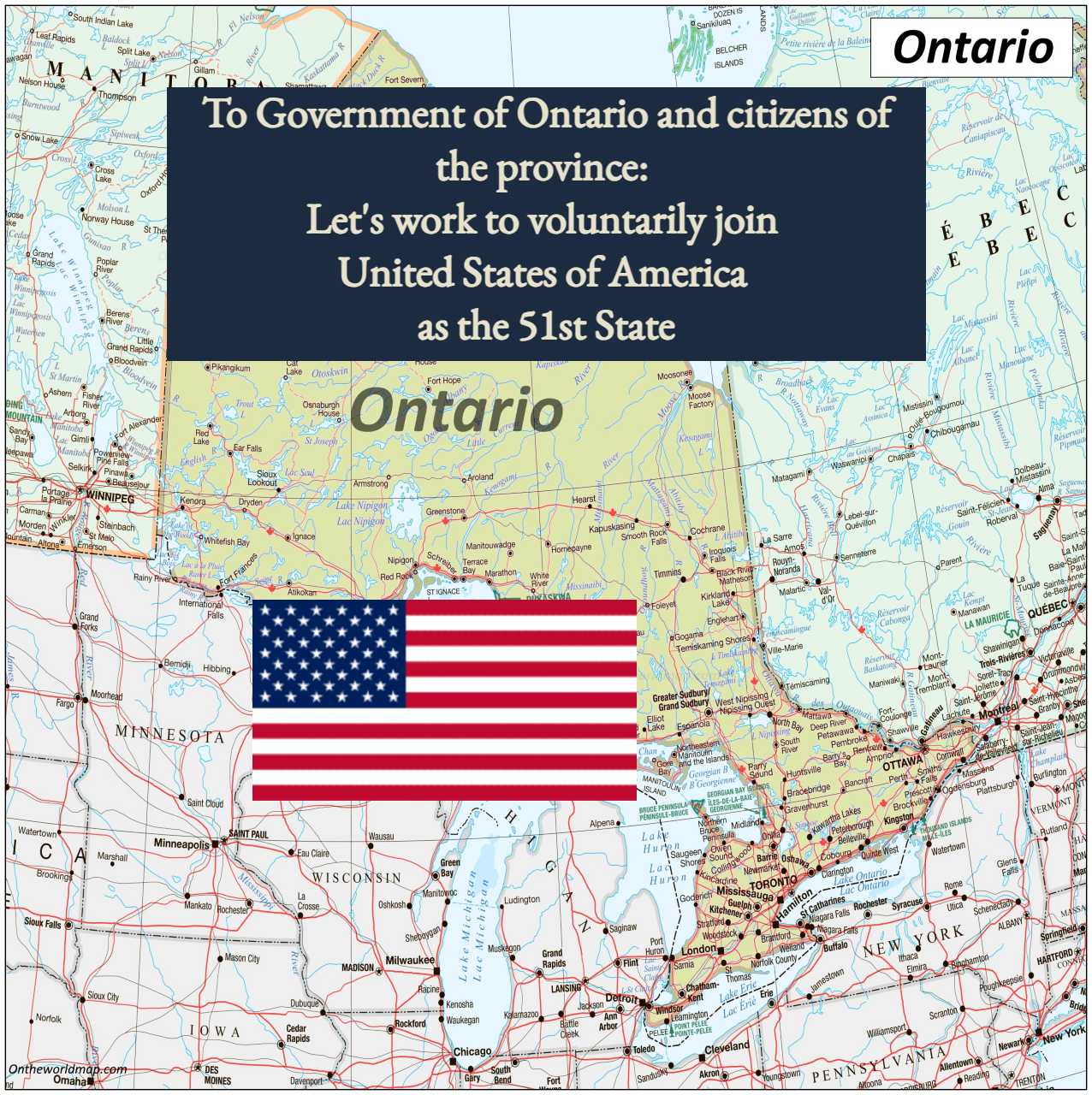
For decades, Canadians have comforted themselves with a quiet sense of moral superiority over our neighbors to the south. We pointed to our healthcare, our parliamentary stability, and our distinct culture. But that veneer is cracking, especially as trade friction, housing unaffordability, and economic stagnation expose the limits of our insular model.
Ontario, the economic engine of Canada, is stalled. We are trapped in a low-growth economic loop, bogged down by a bloated public sector, and tethered to a federal government incapable of protecting our borders, our speech, or our markets.
It is time to stop tweaking a broken system. To secure our economic survival, protect our fundamental liberties, and offer our citizens true mobility, the Government of Ontario and the citizens of the province should work to join the United States of America as the 51st state.
This isn’t a radical surrender; it is a pragmatic realignment. This bold move offers undeniable benefits across the entire political spectrum, tearing down a self-serving establishment that preys on the everyday citizen.
The Illusion of the Status Quo: Who Actually Benefits from Canadian Isolation?
To understand why change is desperately needed, we must dismantle the myth that Canada’s economic and political isolation serves the public good. In reality, the status quo is a carefully guarded racket designed to protect a privileged few at the heavy expense of the majority.
The Political Class: Federal and provincial politicians thrive inside a closed ecosystem where they face minimal true competition or accountability. By stoking perpetual regional divisions and hiding behind complex interprovincial trade barriers, political elites insulate themselves from global standards of efficiency and performance while expanding their own regulatory power.
The Public Sector Bureaucracy: A bloated administrative apparatus across Ottawa and Queen’s Park feeds endlessly off taxpayer resources. For government workers and institutional managers, the Canadian model guarantees high job security, inflated pensions, and endless red tape — funded entirely by a squeezed private-sector workforce that receives fewer and fewer returns for its productivity.
Oligopolies and “Maple-Washed” Monopolies: Canadian consumers pay some of the highest prices in the developed world for telecommunications, banking, groceries, and air travel. Protected by strict ownership laws and regulatory moats, domestic corporate giants hide behind patriotic marketing — using slogans like “Buy Canadian,” “Canada’s team,” or corporate “maple-washing” — to guilt consumers into accepting substandard service and inflated pricing.
The Real Estate Cartel and Political Meddling: Perhaps the most egregious drain on everyday Ontarians is the cozy alliance between political leaders and real estate interests. Whether looking at provincial administrations embroiled in land-use scandals (such as Doug Ford’s controversial Greenbelt maneuvers) or federal architects like Mark Carney managing a national economy dangerously over-allocated into residential housing over productive innovation, the system is rigged. Politicians, high-level bureaucrats, and connected developers profit immensely from an artificially scarce housing market. They use their power to protect inflated property values and friendly portfolios, locking younger generations out of homeownership while pretending to solve a crisis of their own creation.
When domestic monopolies and real estate insiders wrap themselves in the Canadian flag, they aren’t protecting national identity; they are protecting their profit margins. The average Ontarian pays an invisible “patriotism tax” every single day — at the grocery store, on their phone bill, and through suffocating housing costs — all while subsidizing a corrupt domestic class that thrives on keeping Canada isolated.
The Economic and Constitutional Case for the Right
For conservatives and libertarians, the benefit of statehood boils down to two things: economic dynamism and individual liberty.
Ontario’s economy suffers from a severe productivity crisis. By joining the U.S., Ontario businesses would instantly gain unfettered access to a market of over 340 million consumers, entirely bypassing the looming threat of protectionist U.S. tariffs that perpetually jeopardize our manufacturing, steel, and automotive sectors. Furthermore, introducing robust American competition into Ontario’s heavily protected, oligopolistic domestic sectors would shatter monopolies and finally drive down costs for struggling consumers.
Beyond economics, Ontario is facing a profound cultural and institutional drift:
Free Speech: Canada’s lack of a constitutional absolute on free expression has allowed for a chilling effect on public discourse. By adopting the First Amendment, Ontarians would secure ironclad protections for free speech that the Canadian Charter of Rights and Freedoms — frequently bypassed by the “notwithstanding clause” — simply cannot guarantee.
National Security and Sovereignty: Canada’s lax immigration enforcement and vulnerability to foreign interference have compromised our sovereignty. Integrating into the U.S. system brings the weight of American intelligence, stringent border security, and a firm stance against foreign adversaries.
Fiscal Responsibility: Total government spending in Canada weighs down economic potential. Transitioning to a U.S. state model would force a dramatic downsizing of bureaucratic overhead, lower corporate and personal income taxes, and align Ontario with a culture that rewards merit over state dependency and political patronage.
For those who distrust government overreach, the Second Amendment offers an ultimate constitutional check against state authoritarianism — a stark contrast to Ottawa’s systematic dismantling of legal firearms ownership.
The Progressive and Cultural Case for the Left
While statehood sounds like a conservative dream, progressives stand to gain just as much, if not more, from dismantling a stagnant status quo that traps citizens in underfunded, monopolized public services.
For the Canadian left, true progress is often blocked by archaic systems. Joining the U.S. offers an immediate remedy to several progressive grievances:
Dismantling Colonial Shackles: Becoming a U.S. state allows Ontario to finally sever its ties to the British monarchy — an inherently colonial, patriarchal institution that has no place in a modern, diverse society.
Democratic Reform: The Canadian first-past-the-post parliamentary system regularly hands majority control to parties that win barely one-third of the popular vote. As a U.S. state, Ontario would gain two seats in the U.S. Senate and a massive congressional delegation, operating within a system of robust checks and balances and direct executive elections.
Unrivaled Mobility: Right now, an Ontarian who dislikes provincial policy has nine other structurally similar provinces to choose from. As an American citizen, that same Ontarian gains the right to move freely anywhere from California to New York. Progressive Ontarians could relocate to states that perfectly align with their values regarding social safety nets, environmental regulations, and reproductive freedom.
Arts, Culture, and Education: The U.S. boasts the world’s premier cultural economy and the finest post-secondary education system on earth. Statehood would grant Ontario youth domestic access to Ivy League universities, massive federal research grants, and a limitless arena for artists, filmmakers, and innovators to scale their work without relying on restrictive, state-rationed cultural grants designed to protect domestic mediocrity.
Navigating the Transition: Addressing the Struggles and Trade-Offs
No massive geopolitical realignment comes without disruption, and acknowledging the genuine anxieties of Ontarians is vital to the discussion.
The most common fear regarding American integration centers on healthcare. For generations, Canadians have viewed public single-payer healthcare as a defining cultural pillar, and transitioning away from it would present real cultural and logistical hurdles. Critics rightly point out that the U.S. system can be complex, and out-of-pocket costs are a legitimate concern for vulnerable populations.
However, this fear often relies on outdated caricatures rather than the reality of modern American healthcare access. Canada’s current healthcare system is buckling under chronic backlogs, emergency room closures, and months-long wait times for specialist treatments that routinely compromise patient outcomes. By contrast, integrating into the U.S. framework would introduce robust employer-backed and private insurance markets equipped with cutting-edge medical technologies. For the average working citizen, this shift translates to significantly shorter wait times, vastly improved availability of specialized treatments, and greater personal control over medical choices rather than being at the mercy of an overburdened, rationing provincial bureaucracy.
While managing the structural transition would require care, the trade-off yields a vastly superior, dynamic system that rewards productivity and health outcomes over stagnation.
A Bold Path Forward
The status quo is a slow decline. Ontario finds itself caught between a federal government in Ottawa that over-regulates our lives, politicians and real estate insiders who weaponize policy and patriotism to shield crony capitalism, and an international landscape where we are too small to dictate terms.
By joining the United States of America, Ontario wouldn’t be losing its identity; it would be unleashing its potential. We would preserve our local governance as a powerful new state while shedding the parasitic bureaucracies, housing cartels, and corporate monopolies that feast on Canadian economic nationalism.
It’s time to stop looking at the border as a barrier, and start looking at it as our open door to a more prosperous, competitive, and free future.