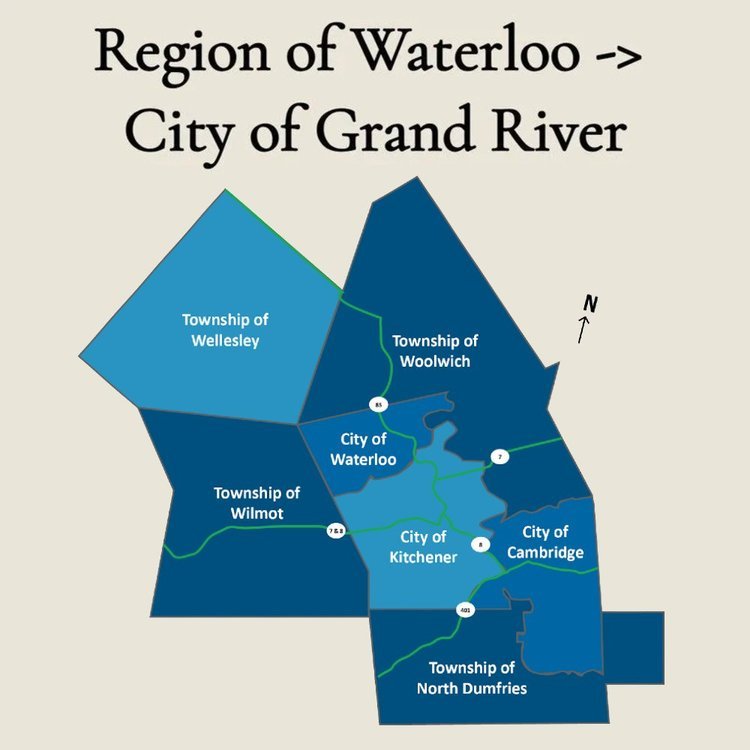
Waterloo Region Restructuring & Rebranding Advocacy: Amalgamate Top-Tier Region of Waterloo, Rename “City of Grand River”
Last updated: 2025/09/08
1. Advocate to Government of Ontario for Dissolution of Top-Tier "Region of Waterloo"
The Rationale: Why This Matters
Reduce bureaucratic duplication: Eliminate redundant services and administrative layers between the regional and lower-tier governments. This could lead to a single point of contact for citizens and businesses.
Streamline decision-making: Accelerate critical decisions, particularly for housing and land development, which are often delayed by the two-tier structure.
Improve local accountability: A single, transparent council would be directly responsible for all municipal services, making it easier for citizens to hold their elected officials accountable.
Lead to long-term cost savings: By consolidating services, a single-tier system could reduce overhead and lead to significant financial efficiencies for taxpayers.
The Historical & Local Context
The Region was created by the province in 1973, a change that was imposed, not chosen by local residents, which has led to a long-standing debate over its effectiveness and purpose.
The recent provincial review of regional governments indicates a continued public and political interest in this issue as a potential solution to Ontario's housing crisis.
The Precedent: Examples from Elsewhere
The recent provincial decision to dissolve the Regional Municipality of Peel (though the timeline has been paused for further review) serves as a direct precedent that the Ontario government has the will and authority to make such a change.
Other Canadian cities, such as Halifax and Winnipeg, moved to a single-tier model decades ago to improve efficiency and governance.
The City of London in the UK uses a two-tier system with a powerful, single mayor for the entire metropolitan area, offering another model for a hybrid solution.
The Plan: Overcoming Obstacles
Requires a provincial government bill to legally dissolve the Region.
A transition board would need to be appointed to oversee the division of assets, debt, and services (e.g., police, public health, social services).
2. Advocate to Government of Ontario for Amalgamation of Lower-Tier "City of Kitchener" With "City of Waterloo"
The Rationale: Why This Matters
Create a single, powerful "megacity": A united city would have a stronger, more coherent voice for the urban core on the national and global stage.
Eliminate duplicated services: Consolidate city councils, fire departments, and recreation programs to reduce administrative overhead.
Allow for integrated planning: Enable more efficient and long-term planning for shared infrastructure like public transit, roads, and utilities.
The Historical & Local Context
The idea of a single "Kitchener-Waterloo" city has been debated since the 1960s.
The two cities already share a common name (K-W), public transit (GRT), and have a high degree of social and economic interdependence, with residents often moving between the two without noticing.
The Precedent: Examples from Elsewhere
The creation of the City of Toronto (1998), which amalgamated six municipalities, offers a Canadian example of a large-scale "megacity" project.
The formation of the City of Ottawa (2001) and the City of Hamilton (2001) provide additional Ontario-specific precedents.
The New York City model of a single, powerful city government with distinct boroughs offers a blueprint for how a united city can still contain separate, locally-branded communities.
The Plan: Overcoming Obstacles
Requires a Minister's Order from the provincial government.
Significant upfront costs for new signage, branding, and merging computer systems.
Requires a clear plan for harmonizing taxes and services, while preserving the unique identities of areas like Uptown Waterloo and Downtown Kitchener.
3. Advocate for Referendum for Citizens of Lower-Tier "City of Cambridge" on Dissolution of City into "City of Galt", "Town of Preston", "Town of Hespeler" & New Status of Blair
The Rationale: Why This Matters
Honour distinct identities: The original communities were forcibly amalgamated in 1973; dissolution would respect the unique historical and cultural identities of each area.
Bring decision-making closer: Allow for local decision-making and development tailored to each area's unique character.
Empower citizens: Give the people of Cambridge the choice to decide their own fate.
The Historical & Local Context
The City of Cambridge was a "shotgun marriage" created by the province in 1973, merging the City of Galt, the Towns of Preston and Hespeler, and the Village of Blair.
Strong local identity persists, with many residents still referring to themselves as being "from Galt" or "from Preston."
The Precedent: Examples from Elsewhere
The de-amalgamation of several municipalities in Quebec in 2006 (e.g., Côte Saint-Luc and Montreal West) shows that reversing an amalgamation is possible in Canada.
The de-amalgamation of a regional municipality in Saint John, New Brunswick is another example.
The Plan: Overcoming Obstacles
Requires specific provincial legislation or an order to facilitate the de-amalgamation process, which is legally complex.
A massive and costly undertaking to divide shared assets, infrastructure, and administrative functions.
4. Advocate For Referendum For Citizens Of Other Municipalities to Decide on Amalgamation with the New Kitchener-Waterloo City or Retain Single-Tier Status
The Rationale: Why This Matters
Present a clear, democratic choice: This single referendum would give each community a direct choice on its future—amalgamation or independence.
Benefits of joining: The new, larger city could provide greater services and a powerful voice on the world stage.
Benefits of staying independent: Remaining single-tier would preserve local control and the unique identity of each community.
The Historical & Local Context
The four townships (North Dumfries, Wellesley, Wilmot, and Woolwich) and the City of Cambridge (or its dissolved parts) have unique rural, small-town, and urban identities that could be preserved.
The referendum would empower them to decide their own fate rather than have a solution imposed.
The Precedent: Examples from Elsewhere
The New York City model of a single, powerful city government with distinct boroughs offers a blueprint for how amalgamation can work without a loss of local identity.
The existence of neighboring single-tier municipalities like the County of Brant shows that different governance models can coexist successfully.
The Plan: Overcoming Obstacles
The referendums would need to be legally binding and held simultaneously in each municipality.
The new Kitchener-Waterloo City would need a clear plan for how it would integrate new communities, particularly rural areas.
Read about Berlin to Kitchener name change, 1916
5. Advocate for Referendum for Name of Metropolitan Area (Regardless of Government Structure) For Strong, United Branding to the Rest of Canada & The World
The Rationale: Why This Matters
Create a single, powerful brand: A unified name would reduce confusion for tourists, investors, and residents.
Foster a shared identity: A new name could help the entire region, with all its different municipalities, feel more connected and united.
Respect local identity: This approach would allow individual cities and townships to retain their specific identities and brands while still benefitting from the strength of a united metropolitan name.
The Historical & Local Context
The region currently operates under a confusing number of names (Waterloo Region, Tri-Cities, K-W), which can hinder efforts in tourism, economic development, and talent attraction.
The Precedent: Examples from Elsewhere
The New York City model is the ideal precedent. The entire metropolitan area is known globally as "New York," while each of the five boroughs (Manhattan, Brooklyn, Queens, The Bronx, and Staten Island) has a distinct identity, brand, and culture.
The Greater Toronto Area (GTA) and the Greater Vancouver Area (GVA) are also widely used and recognized metropolitan names.
The Plan: Overcoming Obstacles
The referendum would be non-binding, as the name of the area doesn't have a legal standing.
A clear process would need to be established to generate name ideas, vet them, and put them to a public vote.
6. Advocate for a Salary Cap of all Municipal Politicians & Staff to be set to the "Living Wage" Salary at maximum
The Rationale: Why This Matters
Eliminate "having your cake and eating it too": Public servants should not be granted power and security through their positions and also benefit from salaries that create an unequal and detached class of citizens.
Promote efficiency and combat bureaucracy: By capping salaries, the public sector would be discouraged from engaging in unnecessary labor that could be automated by AI, forcing a reevaluation of existing roles and pushing for greater efficiency.
Strengthen the private sector and society: Highly skilled individuals would be incentivized to compete in the private sector where their compensation is tied to their value. This increased competition would lead to more innovation and a more dynamic economy overall.
The Historical & Local Context
Municipal salaries, especially for senior staff, have steadily increased, often outpacing the average wage of residents.
This has contributed to a perception that politics and public service are elite professions, separate from the everyday lives of the average citizen.
The Precedent: Examples from Elsewhere
Some private-sector companies, such as Gravity Payments, have successfully implemented a salary cap or living wage floor for all employees, demonstrating that the idea is feasible in practice.
The Plan: Overcoming Obstacles
This would likely be the most politically challenging proposal and would face significant opposition from public sector unions and current politicians.
A by-law or a referendum would be required to legally cap salaries.
7. Petition to Separate from Province of Ontario if no action is taken on other proposals
The Rationale: Why This Matters
As a final resort: If the provincial government ignores all other calls for reform, this would be a final, democratic expression of the region's dissatisfaction.
Address Toronto's dominance: The province is controlled by a Toronto-centric government that benefits disproportionately at the expense of other regions.
Gain true autonomy: By partnering with other major urban centers in Southwestern Ontario (Guelph, Hamilton, London, Brantford, Niagara, and Windsor), a new province could control its own destiny without being subject to the priorities of a distant capital.
The Historical & Local Context
Southwestern Ontario has long felt overlooked by a government focused on the Greater Toronto Area.
This proposal is a modern version of historical movements to create new provinces in Canada.
The Precedent: Examples from Elsewhere
While no Canadian municipality has successfully seceded from a province, the federal Clarity Act lays out the legal and political requirements for such a move, including the need for a clear mandate from the population.
The creation of new provinces like Alberta and Saskatchewan in 1905 demonstrates that new provincial entities can be formed.
The Plan: Overcoming Obstacles
This would be a monumentally difficult and legally unprecedented action, requiring a constitutional amendment that would need to be approved by multiple levels of government.
The process would be a legal and political "nightmare," requiring years of negotiation over the division of assets and liabilities.
A successful outcome would require the formation of a formal, political coalition and a clear mandate from the public through a referendum.
Subheadings and fact details consolidated with the help of Google Gemini.